The Connectivity Standards Alliance (CSA) has released Matter 1.6 (link). Unlike previous updates – such as Matter 1.5, which introduced support for cameras – the new specification does not add any new device categories. Instead, it focuses on practical deployment scenarios and introduces several improvements aimed at real-world use. The most significant architectural change is the introduction of Joint Fabric, a new mechanism for managing devices across multiple ecosystems. It is designed to eliminate some limitations currently associated with Matter‘s Multi-Admin functionality.
Table of Contents
Joint Fabric: Shared Device Management
Until now, Multi-Admin has worked by allowing a device to grant access to a third-party ecosystem – though the devices remain technically organized into separate logical networks, known as Matter Fabrics. This changes with Joint Fabric: In the future, multiple Matter Controllers authorized by the user will manage a single, shared data pool. Every device added to this Joint Fabric is automatically visible to and controllable by all participating controllers. Administrators can be added or removed independently of the devices, and participation counts as a single Fabric on each device.
This helps conserve device memory. Under the Matter specification, certified devices are required to support at least five fabrics simultaneously. In practice, however, that limit can be reached quickly in Multi-Admin environments, particularly when Apple Home is involved. Apple synchronizes Matter accessories through iCloud Keychain, which requires a second, separate fabric. As a result, Apple Home consumes two of the five available fabric slots, reducing the remaining capacity for parallel use with Google Home, Alexa, or Home Assistant.
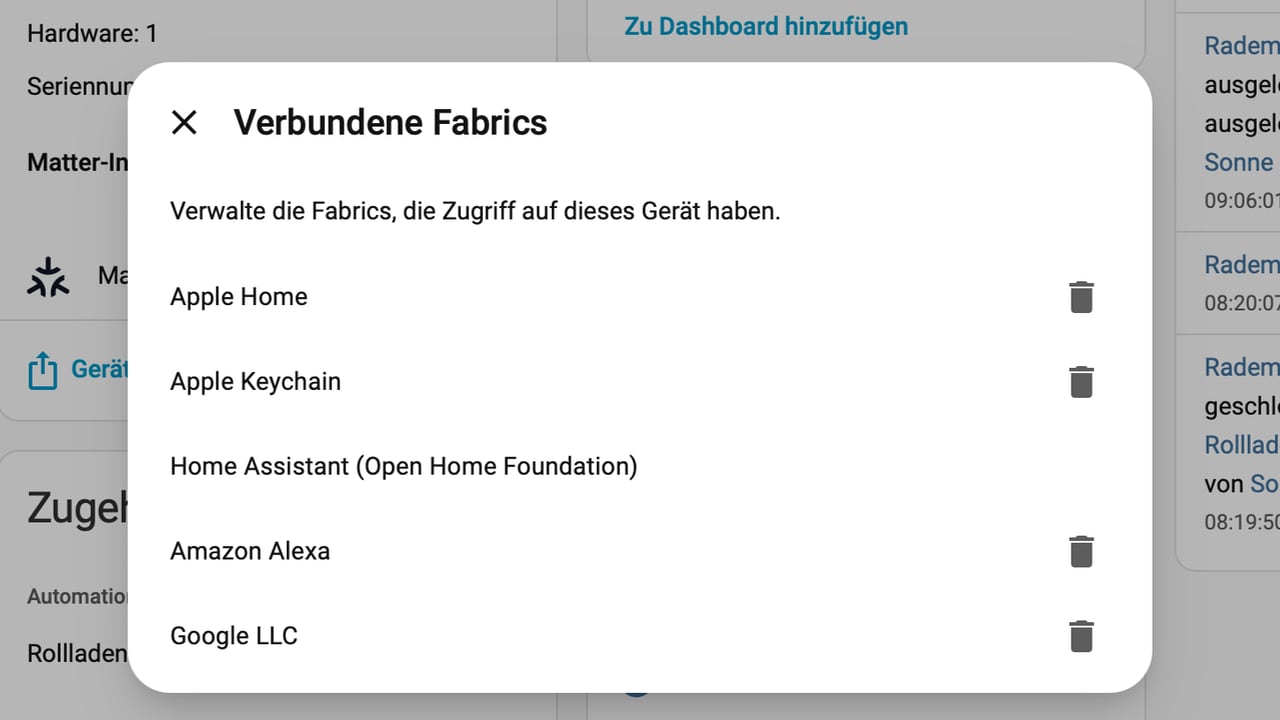
With Joint Fabric, the CSA is targeting scenarios that have traditionally been cumbersome to implement: handovers in newly constructed homes, households using multiple smart home platforms simultaneously, or professionally managed properties where building managers, tenants, and service providers all require access at the same time. From a user perspective, the concept promises that a device can appear in any participating ecosystem without having to be set up separately in each one.
Technically, the solution goes a step beyond Enhanced Multi-Admin, which was introduced with Matter 1.4 in 2024. Both features aim to solve the same fundamental problem: making a Matter device available across multiple ecosystems without requiring separate onboarding for each platform. Enhanced Multi-Admin achieves this through synchronization, known as Fabric Sync. With one-time user authorization, fabrics can exchange information about devices and automatically make them available to other platforms. The fabrics themselves, however, remain technically separate, and each ecosystem still consumes its own fabric slot on the device.
Joint Fabric takes a different architectural path, which the CSA describes as a “a new and distinct approach” that “that works differently from previously introduced methods.” It remains to be seen how quickly it will be put into practice. Things went very quiet around Enhanced Multi-Admin after its announcement in November 2024. To date, there is no Matter ecosystem that synchronizes its Fabric with others. Hopefully, Joint Fabric will be more successful.
Thermostat Suggestions: Advice Instead of Commands
Another notable addition concerns HVAC control. Until now, Matter platforms have simply sent commands to thermostats, which execute them directly. With Matter 1.6, Thermostat Suggestions introduces a new, time-limited recommendation mechanism tied to the thermostat’s own presets and operating logic. The device itself determines whether to follow a suggestion based on user preferences and current conditions.
Such mechanisms can be particularly useful for home energy management. Dynamic electricity tariffs and utility demand-response programs also require a certain degree of flexibility (see also: “If You Want to Turn Customers Against Electric Mobility, You Throttle Their Charger”). In some situations, heating commands may conflict with economic considerations. Likewise, manually adjusted settings can be overridden almost immediately by a command arriving from a smart home ecosystem.

With Thermostat Suggestions, a thermostat can recognize when a request is unlikely to reflect the user’s intent and postpone its execution. How intelligently this process works in practice will depend entirely on the manufacturer’s implementation. The specification defines the framework but not the actual decision-making logic.
NFC-Based Commissioning – Even Without Power
Less spectacular but relevant to everyday life is the third key innovation: Matter 1.6 allows devices to be fully set up using NFC (Near Field Communication) eliminating the need for Bluetooth. Matter 1.4.1 already introduced NFC onboarding payloads, allowing setup information to be stored on an NFC tag. However, the actual commissioning process still relied on Bluetooth Low Energy (BLE). With Matter 1.6, the entire setup process can now be carried out via NFC.
In practical terms, this means a light bulb can be commissioned before being installed in a socket, or an in-wall switch before line voltage is even available. In larger deployments, multiple devices can be provisioned in advance and activated only once they reach their final installation location. For end users, the process is reduced to a simple tap of a smartphone against the device.
This is particularly useful for permanently installed products such as ceiling lights or in-wall actuators, where the final mounting position may make scanning a QR code difficult. With NFC-enabled Matter devices, no QR code scan is required for commissioning. And because the setup credentials are stored inside the NFC chip, they cannot be lost.
Other Enhancements at a Glance
In addition to the headline features, Matter 1.6 introduces several other improvements:
- Groupcast, for synchronous control of multiple devices, is being introduced. It has been implemented but is currently disabled. The “provisional” designation means that the feature has been specified but cannot yet be certified.
- Device capabilities and limitations: Devices can report their features and operational limits in a standardized way, enabling controllers to present more accurate information across ecosystems.
- Event history for security sensors: Sensors can expose both real-time status information and historical events in an interoperable manner, providing a more complete record of activity.
- Removal status for smoke and CO alarms: Alarms can indicate when they have been removed from their installed location, helping identify potential protection gaps.
- Partitioned Certificate Revocation Lists (CRLs): Building on the CRL support introduced in Matter 1.4.2, revocation information can now be managed in smaller, independent partitions. This makes Matter‘s security infrastructure more scalable and easier to manage as the number of certified devices continues to grow.
Share this information: