2025 was an eventful year for Matter. The number of committed manufacturers continued to grow. Companies such as Busch-Jaeger (ABB), Maco, and Warema show that professional suppliers are increasingly backing the smart home standard as well.
At the other end of the price spectrum, Ikea is driving customer adoption: the home furnishings group has brought Matter-certified products to market for well under ten US dollars. Cameras in Matter 1.5 further rounded out the already extensive specifications. But what about the open issues? Last year’s status review concluded that the Matter project still had considerable catching up to do. What has changed since then? And how will the development continue?
Contents
Progress in the Thread Protocol
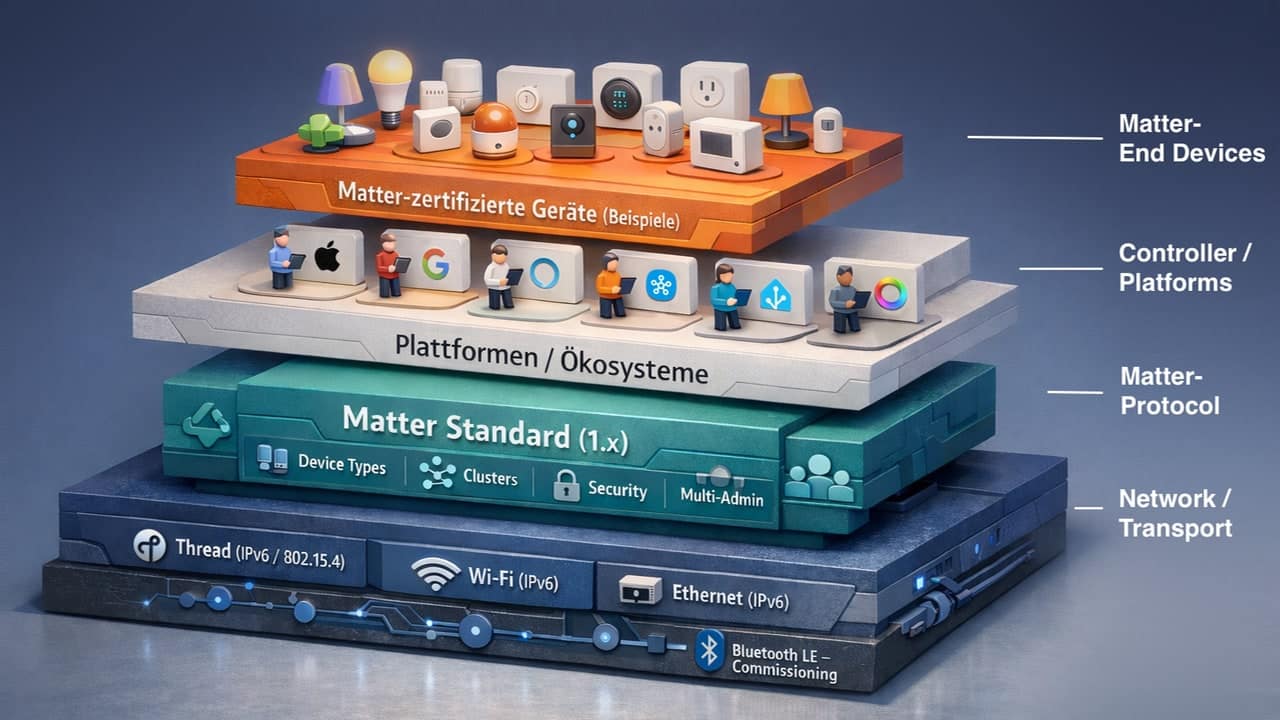
The wireless protocol Thread is one of three connectivity technologies in the Matter standard. It has been criticized on occasion – due to competing mesh networks, short battery life, and a limited product selection that threatened to shrink even further following the withdrawal of manufacturers such as Nanoleaf. The good news is that progress has been made in all three areas.
The Range of Products Is Growing
The clearest signal comes from Ikea. With a Thread offensive comprising more than 20 new products, the company is expanding the installed base. Aqara, Bosch, Home Assistant, Level, Meross, Philips Hue, Yale, and others have also brought new products to market. In the professional segment, companies such as ABB, Maco, and Warema have joined in, while Samsung has quietly equipped a growing number of its devices with a Thread Border Router. Further announcements are expected at CES in January and at the Light + Building trade fair in March 2026.
Extending Battery Life
One advantage of newly introduced products is that they are usually certified according to current Matter specifications. Battery-powered devices benefit in particular, as their behavior within the standard has been optimized multiple times and made more energy-efficient. Matter 1.4, above all, introduced improvements in the power consumption of “sleeping” devices: sensors or wireless buttons that are inactive need to check in less frequently without losing their status within the network. This saves energy. Products certified under version 1.4 are now gradually reaching the market.
The goal is to make them as energy-efficient as their best Zigbee counterparts. The older Zigbee protocol has an advantage here because it has been optimized for efficiency over decades. It allows for longer sleep cycles, requires less computing power for encryption, and does not carry the protocol overhead of IPv6. The radio technology is mature, as Zigbee has existed for more than 20 years. The Thread protocol has been around for only about half that time and gained significance only with the advent of Matter. New, efficient chips such as Nordic Semiconductor’s nRF54 series (link) are intended to help close this gap.
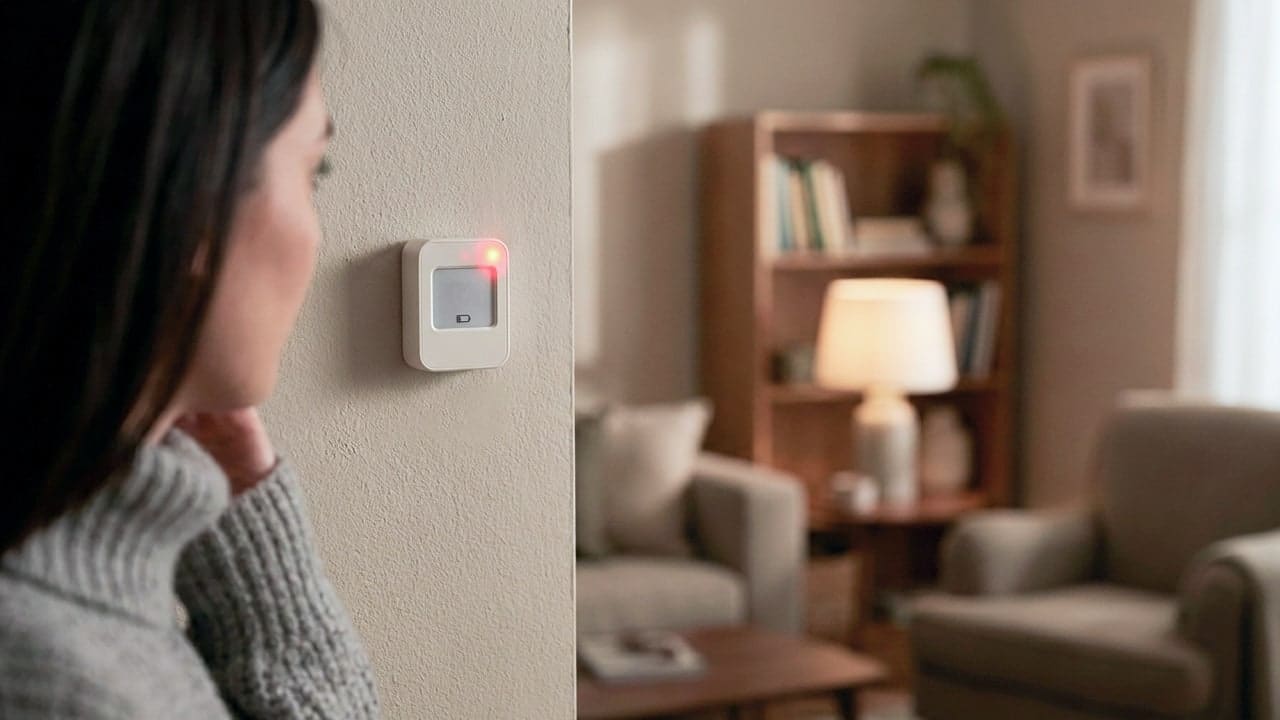
Device manufacturers such as Aqara currently still report shorter battery runtimes. For the FP300 multi-sensor, which supports both protocols, a Zigbee operating time of up to three years is specified (link). With Thread, it is more likely to be two years. In practice, the values can be significantly lower because they are also determined by factors that are beyond the scope of any certification. For example, unstable Thread networks or Border Routers with poor connections lead to more radio traffic. Devices wake up more frequently to search for a connection to the nearest node. With multiple platforms in Multi-Admin mode, each ecosystem polls the devices – causing them to wake up more often or stay awake longer than planned.
A seamless Thread network with sufficient power-supplied devices in the right places can therefore extend battery life, as can firmware updates to a newer Matter version, provided the manufacturer offers them. However, many users are likely to be unaware of these connections. They attribute disappointing results solely to the product in question.
Harmonization of Networks
The transition to Thread 1.4 represents an important step toward stable, cross-vendor networks. The latest specifications for the wireless protocol – published in fall 2024 by the Thread Group (link) – standardize the exchange of access data (Thread Credentials). This allows newly installed Border Routers to join an existing network instead of automatically setting up their own mesh. Parallel networks are a common cause of connection problems in everyday life and frustration among users.
SmartThings was the first to implement this feature, followed by Ikea. Ann Olivo, Head of Marketing at the Thread Group, told US magazine “The Verge” that new Border Routers can now only be certified with Thread 1.4 (link). Applications based on the previous version, Thread 1.3, will no longer be accepted as of January 1, 2026. In addition, the Connectivity Standards Alliance has tightened its Matter specifications: since version 1.4.2, border routers and so-called network infrastructure managers (NIMs) must be certified for Thread 1.4.
Now it is up to the platforms to implement these improvements. Many ecosystems are still at the Matter 1.2 or 1.3 stage. The fact that some – such as Amazon – claim to support the Matter 1.4 SDK does not prevent them from offering only a selection of the features it contains (link). Time is on the side of the standard and a widespread transformation to Thread 1.4. Whether this will be achieved by 2026 remains to be seen.
The Role of Matter Platforms
Which brings us to the elephant in the room: the major ecosystems and their handling of the standard. The way Amazon, Apple, Google, and others implement the specifications sometimes contradicts Matter‘s product promise because their approach is neither consistent nor transparent. For example, while SmartThings is moving at a rapid pace and has already announced full implementation just a few weeks after the release of Matter 1.5, other platforms are stuck on version 1.2. Or, like Google Home, have not even made the generic switches of the first Matter release available to their users (link).
Differences Between Ecosystems
In practice, this leads to confusion among consumers. Buyers of the new Ikea products, for example, find that their Bilresa remote control does not work in the Google ecosystem. The same applies to the Klippbok water detector, which also fails to integrate with Amazon because the Alexa ecosystem does not yet support leak sensors. Reddit, user forums, and the matter-smarthome email inbox are full of anecdotal observations on this topic.
Even if the product is recognized, its range of functions often varies. It may seem obvious that an exotic control element such as the scroll wheel on the Bilresa remote control with rotating disc is only fully supported on Ikea’s Dirigera Hub. However, the fact that normal buttons can be programmed for single, double, triple, or quadruple presses and for short or long presses, depending on the platform in use, is one of the big surprises that the Matter standard has in store.
Matter Versions Clash
In addition, the platforms do not alone decide which functions a product provides. The certification of the device also has a say in this. Since Matter 1.4, for example, it has been possible for robot vacuum cleaners to move to a specific area of the home and only start cleaning there. This capability is defined in the so-called Service Area Cluster. To use it, the platform and robot must support the specification. If the vacuum cleaner is certified according to Matter 1.2, t lacks the necessary software requirements.
An ecosystem that supports Matter 1.2 or 1.3 must also be ruled out here – unless the provider has implemented the Service Area Cluster anyway. This is the case with Apple Home: since iOS 18.4, the platform has been steering corresponding robot vacuums from providers such as Roborock or SwitchBot into the desired room. Despite the fact that most parts of Matter 1.4 are still missing in Apple Home. Sounds confusing? It is for end consumers because the standard turns out to be a bit of a mixed bag. Sometimes the only way to find out what a device can and cannot do is to start using it. Even the colorful “Works with …” logos used by the platforms do not provide full clarity here. Especially since providers such as Ikea have dispensed with them altogether and now only print the Matter logo on their packaging.
More Clear Communication, Please.
It may seem different to early adopters, but the Matter standard is making significant progress – and at a remarkable pace. Within three years, it has gone from a handful of devices to a comprehensive product portfolio. The overview at matter-smarthome.de lists over 750 products, most of which are already available or about to be launched. One reason this list is not longer is also due to the fact that we do not count country versions and model variants with different colors or dimensions. And that Matter’s Distributed Compliance Ledger (DCL) is not sufficient as a source of information for us. In the standard’s blockchain directory (link), devices often appear before they are certified – with little more than their name. For an entry on matter-smarthome, the data should be more comprehensive.
Too Little Information for Users
The lack of information will likely remain a stumbling block for Matter in 2026. Hardly any vendors and only a few platforms communicate publicly about how far they are with implementation. References to Matter are frequently hidden in the technical data – and when they are available, they say little about exactly which specifications or functions are supported. This is where the open, cross-manufacturer approach collides with companies’ desire to promote their own solutions and systems above all else.
A Revolution from Below?
Should this be discouraging? Not really. The seeds have been sown and Matter is spreading as a grassroots movement: decentralized, without any set direction. The standard is growing from the bottom up into the smart home sector. It is preparing the ground for new Matter Controllers and smart home solutions that could become an alternative to the platforms mentioned above. Differences in the existing ecosystems have to grow out.
Of course, early blooms such as Ikea’s market entry, a growing number of B2B applications, and new servers from Home Assistant or Homey should not detract from the gaps in this vegetation. But if Matter maintains its growth, these spots will disappear. Nature simply needs time to do its work.
Share this information: